The Elder

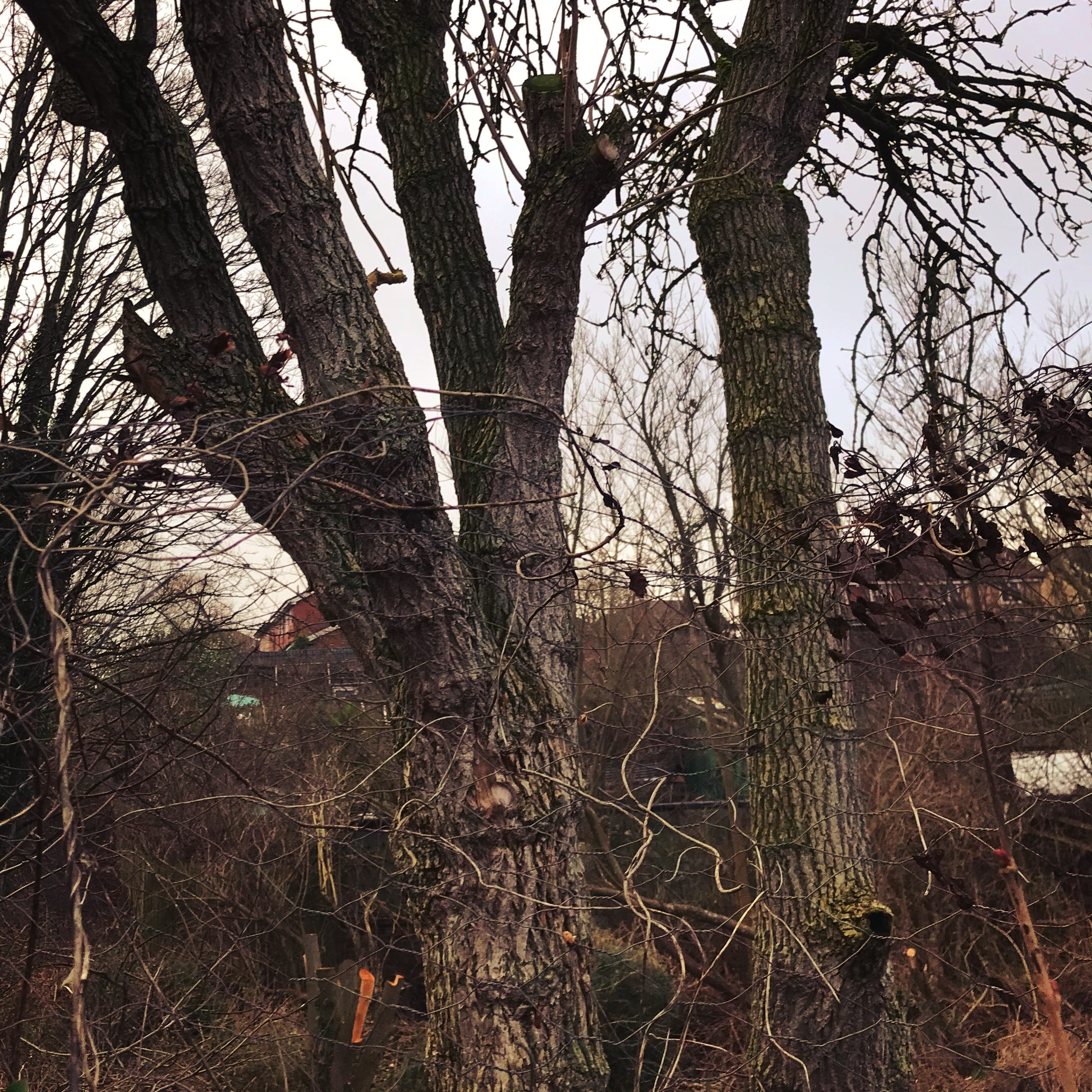
I have spent nine years or so in the company of an elder tree. It stands just outside our allotment plot, by the fence and spreading over it; you might say it looms there, or lours there. It’s big for an elder, maybe as much as ten metres tall, and old, though not ancient. When we first took on the plot the council had left for us a huge pile of rubbish in the north-east corner; the elder branches extended to and rested on this pile, and so this became one of my first allotment jobs: cut away the elder to reach and clear the rubbish.
I wasn’t unfamiliar with managing elder. Young shoots are in fact easy to deal with: they’re hollow and pithy and snap off readily: no tools needed. But an aged elder is quite different to a young elder. The branches are multitudinous; rubbery and lichen-clad, and seem to spray high into the air, always just out of reach. I recall perching at the top of my old wooden ladder, brandishing a broom, trying to strike the thinner branches from the tree (it didn’t work.) The girthier timber has a tremendous weight to it, and a saw sticks fast as you near the sappy centre. Worst, and most surprising, is the smell produced if you do manage to separate a limb. I don’t think I’ve smelt anything like it - a choking, gassy, chemical release that seems almost to be screaming at you to leave this tree alone. I remember recoiling, pulling my woolly hat off, and covering my face with it while I recovered. Yet bizarrely, I can’t seem to find any corroboration of this smell online. Was my elder particularly, unusually noxious?
Elder is supposed to release arsenic fumes when burnt, and, perhaps relatedly, has a formidable folkloric reputation: a defence against evil if planted outside your home; an invitation to it if brought inside. If one made the mistake of burning it, one would summon the Devil. That odour – both when burnt and when cut - must indeed have made people think that something particularly malevolent was inside the elder, or embodied by it. But though I’m very interested in folklore, I’ll admit to having little patience with recent ideas of ‘folk horror’, or of claims to the perception of the numinous in the every-day. It feels a step removed from any culture that may have truly inhabited such ideas. The world is strange enough: as it is, or as it appears to be. And so while I know that the elder does what it does because it’s evolved to do so, and is taking its advantages in the world (light, nutrients) in the way that it must, that doesn’t mean I don’t feel the force of it as a presence in the world - in the same way that I would, for example, react to a panther suddenly dropping from its branches.
And I certainly do feel something odd about the elder: a kind of repelling force, an anti-magnetism that brings me to a self-conscious, almost respectful quietness when I’m near it. And as the years have passed I’ve felt more and more that that whole corner of the plot is negatively affected: the hedge of hazel and blackthorn we planted along the fence-line took so much longer to establish there, and the nearby raspberry patch only really took off when the rats in the compost bin began excavating the completed compost onto the raspberry bed.
A couple of years ago I discovered (or read somewhere: again, there seems to be little verified information) that elders are actually allelopathic: they release chemical toxins via their roots which suppress the growth of plants within their purlieu. If true, this explains the slowness of the hazel and the blackthorn, but also the strange hesitancy of even the brambles beneath its shadow. I had already, I think, semi-consciously noted the effect, and had begun to use the area around the base of the tree to store the seemingly never-ending rubble I dug out of our heavy clay soil. After this was cleared, the elder ground became a wood pile, which grows year by year, and which I hope (I haven’t yet moved anything to check) is becoming a palatial home for beneficial invertebrates.
The elder appears in virtually every photograph I have of the allotment – that same stolid, unwavering shape, humming gently in the image. Perhaps I’m beginning to view the elder as a kind of sentinel of the plot – just like the ancients who planted them around their bothies; a permanent landscape marker becoming untouchable through age and sure familiarity. And left uncut they do make a handsome tree - multi-stemmed with a pinky-brown, ridged and corky bark, flowering with that indescribable sweet smell in mid-summer, and opening to a rounded canopy that seems to simultaneously reach skywards whilst falling close to the ground in one neat arc.
But I still size it up regularly, wondering if I’m game to tackle it again with the bow saw: what light we would gain! How the raspberries and the cobnuts would thrive! And, of course, the elder would live, and probably thank me for it, shooting up those pithy rods to the height of two metres in a season. Then I remember the sheer weight of the thing, the dull bite of the saw in its creamy flesh - and the smell. And so our sentinel still stands, for now.